
Am I Bound By A Past Self’s Promise?

Introduction
The most beautiful truth of being human is that we are never the same river twice, forever reshaped by tide.
Imagine a passionate idealist 18-year-old who signs a personal pledge never to work for a corporate entity or a young person who enters into a lifelong personal commitment. 12 years later, at thirty, their life circumstances, family responsibilities, and fundamental values have completely shifted. A promise is often traditionally understood as a binding moral contract. However, under normal circumstances, a contract requires two different parties. What happens when the one who made the promise and the one who must keep it are the same biological individual but separated by more than a decade of psychological evolution?
This dilemma exposes a deep philosophical tension between our desire for personal consistency and our capacity for growth. The core question is ‘Does a choice you made years ago have the right to dictate your life today, or should you always be free to change your mind based on who you are right now?’
This essay further argues that we are not permanently bound by past self-promises as if they were permanent legal handcuffs. Instead, a past promise is an inherited moral trust. It should be kept only if the core values that gave rise to it remain vital to who we are in the present today. We are the stewards of the history of our lives, not prisoners.
The Case for the Past Self
To understand why a past promise should hold authority over our present lives, we must first look at the moral weight of how we construct a human identity over time. A long-term commitment is not a casual guess about the future; it is an act of architecture. When a young version of us decides to pursue a specific goal, commit to a strict ethical code, or make a profound personal vow, they are investing their 18 years of life experience (limited currency of time), hope, and youthful energy into a single destination. The past version of ourselves is, at its core, a “vulnerable creator”; they did the hard work of building the foundation, closing off all alternative possibilities, and absorbing the cost of early sacrifices under a singular fundamental assumption that their future self would be a reliable partner who would complete the building. Because this past self now exists only in psychological memory, which means it can not enforce its commitment, they are completely powerless to defend their investment. If the self abandons that original plan simply because it has become hard and inconvenient, the past sacrifices have become retroactively emptied of their meaning.
To provide strong philosophical ground for this obligation, we can take the insights of Charles Fried’s work Contract as Promise. In this work Fried argues that a contract is both morally and legally binding because it invokes a convention of absolute trust that is created through promises. When we make the promise to another person, we intentionally invite them to rely on our word, and when we break the promise, it is a direct attack on their dignity. Although Fried focuses on agreement between different individuals, this same structure of trust can exist across the stages of a single person’s life. When an 18-year-old self made a profound vow, they acted in completely good faith; they utilised their autonomy at that time to shape a meaningful life and trusted themselves as caretakers of that vision. Therefore, respecting past choices is not an act of blind stubbornness; it is an act of self-respect. If the choices we made today can be effortlessly removed by our future selves tomorrow, then our present act of free will is ultimately an illusion. To remain a coherent and rational identity throughout life, our words must have a lasting moral authority, which cannot be erased by the passing of a decade or the shifting of mood.
The Case for the Present Self
Yet, this image of a unified, self-trusting, lifelong self relies on an assumption that the person who made the promise (18-year-old self) and the person who must keep it (30-year-old self) are identical. When we change the focus from the idealized architecture of the past to the psychological reality of the present, this chain of identity begins to break. If the present self sees itself as the caretaker of the past self’s dream, it risks turning the present life into a museum of dead intentions. At some point the present self must look at the blueprint they have inherited and ask, ‘Why should a ghost from 12 years ago have authority to govern an evolving present?’
To weaken the past claim over the present, Derek Parfit’s Reasons and Persons offers a powerful alternative. He argues that there is no deep, permanent, unchanging “ego” that remains completely identical from birth to death. Instead, personal identity is a matter of degree and depends on changing psychological connections such as shared memories, immediate beliefs, and active desires. Over the period of twelve years, almost every cell in the human body is replaced, and more importantly, our psychological mind undergoes a massive shift. Because these internal connections fade so drastically over decades, if the direct psychological links between your past self and your present self have faded away, then your eighteen-year-old self is not your partner. Metaphysically speaking, they are practically a stranger.
This realization completely dismantles Charles Fried’s claim that breaking a self-promise is a betrayal of autonomy. Parfit illustrates this with his famous thought experiment of the Young Russian Nobleman. Imagine a young, deeply idealistic aristocrat who signs over his future inheritance to the local peasants, making his young wife swear that even if his future self changes his mind, she will ignore him. Decades later, the nobleman returns as a middle-aged man, his values completely changed, and he genuinely wants to keep the land for himself. Parfit asks us to consider the wife’s moral dilemma: to whom does she owe loyalty?
Parfit argues that the older nobleman is effectively a different person from the young man who signed the paper. Therefore, if the young man uses a past contract to permanently bind the older man, he is not exercising self-control; he is committing an act of coercion. He is a stranger from the past reaching forward through time to bully and enslave a living person.
Applied directly to our twelve-year timeline, forcing a thirty-year-old adult to struggle under an obsolete corporate ban or an outdated personal vow is not an act of high moral integrity. It is an act of internal tyranny. It allows a well-meaning but fundamentally uninformed teenager from over a decade ago to dictate the career, relationships, and happiness of an adult who actually has to live through the real-world consequences today. The river has changed, the person has changed, and the present self has a right to be free.
The Inheritance Model of Promise
After having understood the limits of the architectural obligation of the past self and the radical liberation of the present self, we reach a philosophical impasse. If we completely obey the past self, we become passive museum curators of our past choices, maintaining obsolete structures at the expense of our living happiness. Meanwhile, if we completely follow the present self, our long-term agency collapses into a series of disconnected, untrustworthy moments, rendering us incapable of making a promise that sticks.
The solution to this problem is possible only if we shift our focus from abstract metaphysics to the actual psychological foundations of human action. This redirection provides the basis for a new concept of commitment: the Inheritance Model of Promise. To build this model, we must draw on Bernard Williams’ work, first ‘The Makropulos Case: Reflections on the Tedium of Immortality’ and second Persons, Character and Morality.
He argues that what gives human life meaning and makes it worth living are our ‘categorical desires’: those deep, identity-defining commitments and passions such as creative impulses, a profound love, and moral inspiration. If an eighteen-year-old makes a lifelong promise, that promise is inspired by a categorical desire. However, with more than a decade of life experience, our psychological state can naturally evolve. If a clear desire has gradually decreased, not due to laziness but due to genuine intellectual maturity, then pretending to maintain that passion in the present is not virtuous. It makes our lives motionless, trapping us in meaningless commitments.
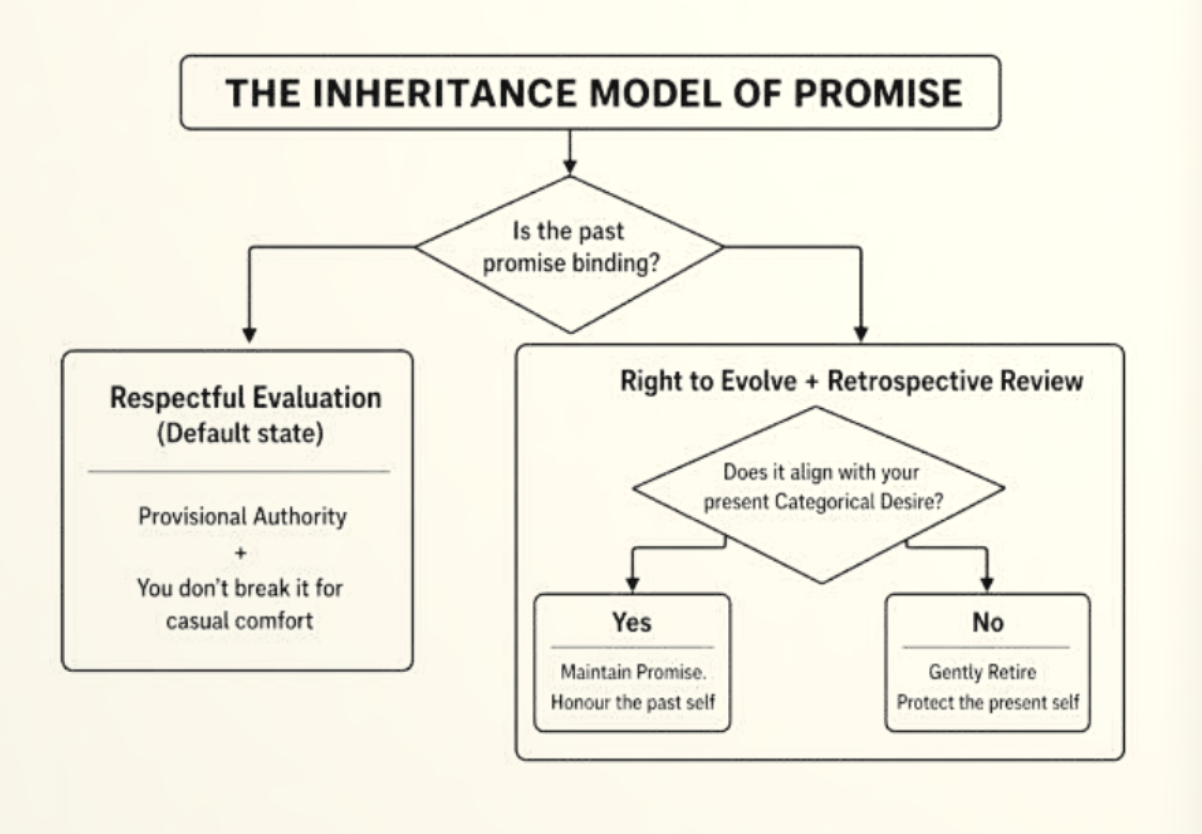
The Inheritance Model of Promise suggests how we should treat a promise through the example of an inherited family business. When we apply this model, we know the way of ‘holding and changing’ the promise:
Respectful Evaluation: When you inherit an old family business from your parents, you don’t shut it down on the first day just because you don’t want to work today. Similarly, when a past promise seems difficult to fulfil today, it can’t be abandoned out of laziness or immediate inconvenience. It is the duty of the present to respectfully evaluate the time, hopes, and sacrifices of that “vulnerable creator” of the past.
Right to Evolve: But if your perspective on life has been completely changed over time, and the categorical desire behind that past promise has now substantially diminished within you and is no longer aligned with your present categorical desires, then you have every moral right to change that promise. If forcefully carrying that legacy is mentally draining your present life, it is wise to close that business (promise) or give it a new path.
The critical boundary within this model is the distinction between sloth and growth. If you abandon a past promise simply because it has become challenging, boring, and inconvenient, that abandonment creates a guilt-laden failure of will and betrays the past self who made the promise. But if you abandon it because your fundamental categorical desires have evolved and matured, because fulfilling the past promise would require you to wear a false identity, then walking away is an act of psychological survival. In the inheritance model, a past promise retains authority over us only as long as it aligns with a living, authentic, and evolving conception of a good life.
Framework of The Inheritance Model of Promise
Conclusion
Ultimately, personal identity is not a static mountain; rather, it flows like a river. A promise should act as a bridge that connects the different chapters of our lives, but it should never become a wall that stops life from moving forward. Human growth is not a betrayal of our past; on the contrary, it is the true purpose of living.
To answer the central question of this essay directly: no, you are not bound by your past self’s promise. You are bound, however, to treat that promise as a profound trust and historical commitment. It deserves your deep attention and respectful evaluation. But if you have outgrown the foundational passion through moral and intellectual maturity, you have the right to evolve and gently retire it, by viewing yourself as a steward of your inheritance rather than a prisoner of your history. We honour both the ‘vulnerable creator’ we once were and the autonomous person we are today.