
Cringe As a Social Fact
Abstract
Social ontology has mostly studied formal institutions and explicit norms. It has said less about the informal, emotional reactions through which people keep one another to the norms of everyday life. This paper analyses one such reaction, “cringe”. I argue that the cringe response is a vicarious aversive reaction to a performance that the observer takes to have failed in its bid for regard from an audience. A behavior is cringe for a community when this response is the typical reaction to it and members expect one another to react in this way. The analysis separates cringe from embarrassment, shame and blame. It explains how cringe regulates behavior without institutional backing, and why the standards it enforces tend to follow those who are most visible in a community. I argue that cringe is a social fact of a light kind: it depends on practice and mutual expectation, not on status functions or joint commitment. I end by considering the ethical risks of such a mechanism and by answering four objections.
Keywords: Cringe · Social ontology · Informal norms · Vicarious embarrassment · Blame · Power · Social construction
1. Introduction
What does it mean to say that something is cringe? People say it of a LinkedIn post, a brand’s jokes or a speech at a wedding. They say it as if it were a plain fact about the thing. Yet the word names a reaction, and it is a reaction that people share. This paper asks what that reaction is and what makes a behavior cringe for a community.
The question matters for social ontology. The field has mainly studied facts that depend on institutions, explicit rules and formal recognition, such as money, property and marriage (Searle, 1995, 2010). It has said less about the informal reactions through which people hold one another to everyday norms. Sociologists, economists and legal theorists have long argued that such reactions do real work (Elster, 1989; Scheff, 1988; Sunstein, 1996). Social ontology has not yet asked what kind of fact an informal reaction can produce. Cringe is a good case to ask it of. It has no authority behind it, no codified rules and no formal sanction, and yet it visibly changes what people do.
I make three claims. First, the cringe response is a vicarious aversive reaction to a performance that the observer takes to have failed in its bid for regard (Section 3). Second, a behavior is cringe for a community when this response is the typical reaction to it and members expect one another to react in this way (Section 4). Third, this analysis explains how cringe regulates behavior without institutional backing, and why the standards it enforces tend to follow those who are most visible (Sections 5 and 6). I then argue that cringe is a social fact of a light kind (Section 7), consider the risks of such a mechanism (Section 8) and answer objections (Section 9).
2. Two Examples
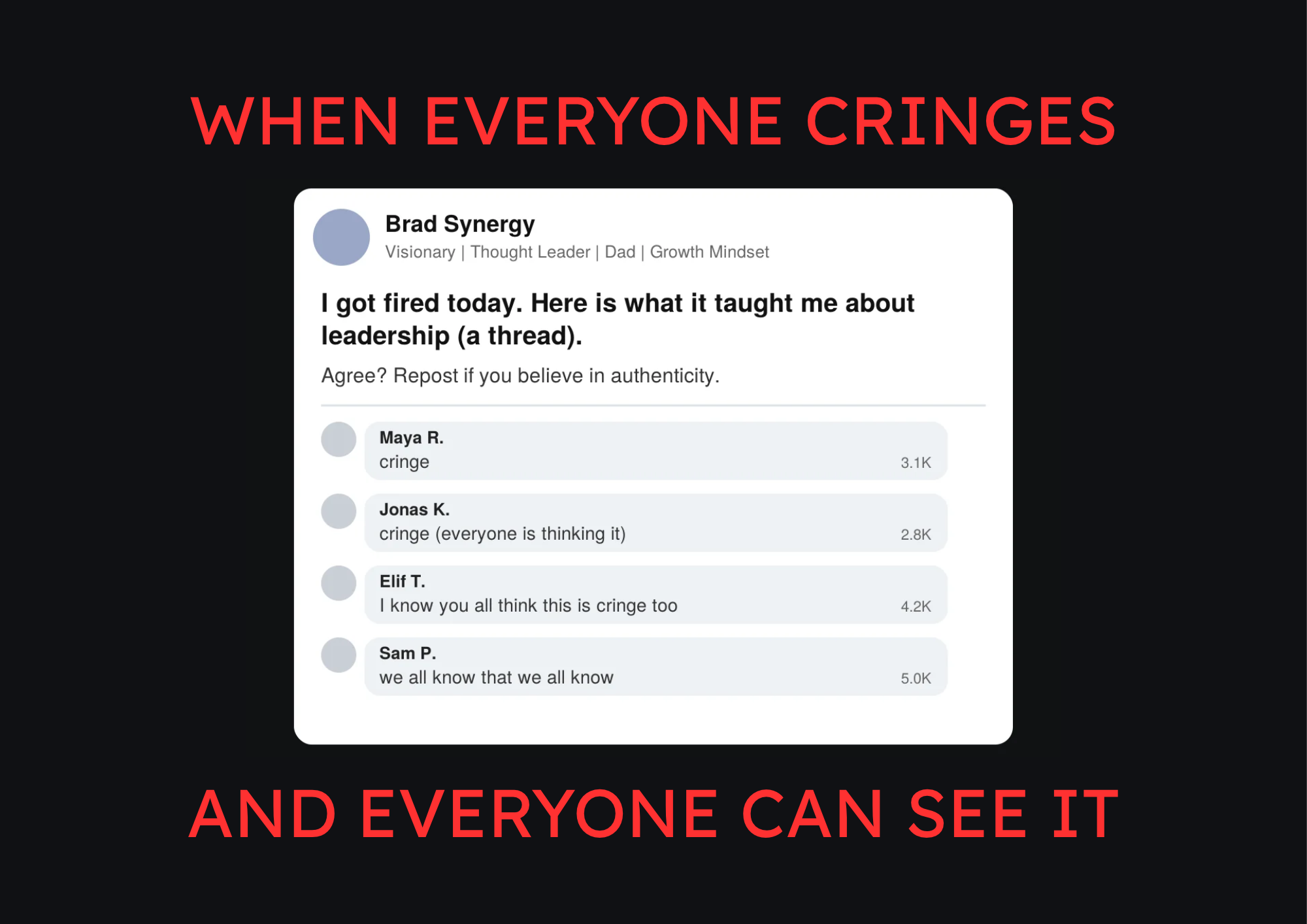
The language-learning company Duolingo is known for a social media voice in which its owl mascot answers hostile comments with mock threats and ironic self-mockery. This voice is often called cringe. So are many LinkedIn “thought leader” posts, especially those that move from personal hardship to professional triumph.
Four features of these cases will matter later. First, what is judged is a performance, not a person: the post, the joke, the tone. Second, the people judging are observers, not the performer. Third, the judgment is shared: it is repeated, quoted and passed around. Fourth, companies and individuals change how they present themselves in order to avoid it. None of this involves a broken formal rule, a verdict from an authority or a formal penalty. If anything has been broken, it is an implicit norm about how to present oneself to an audience.
The idea of context collapse helps to explain why LinkedIn posts attract the label. Marwick and Boyd (2011) use this term for the way online platforms merge audiences that would be separate offline. A post written in the register of one audience, such as professional contacts, is read by strangers and critics who never agreed to be that audience. The register then looks out of place. As I argue below, that kind of failure is what the cringe response answers to.
I use online examples because online reactions are visible: they can be seen being made and being passed on. The analysis is not limited to digital culture. A wedding toast or a classroom presentation can be cringe in the same sense.
The examples raise a puzzle. How can an evaluative practice with no institutional backing regulate behavior? Section 6 answers it.
3. The Cringe Response
3.1. What the response is
I start with the reaction itself and call it R. R is a vicarious aversive reaction to a performance that the observer takes to have failed in its bid for regard from an audience. Each part of this definition does some work.
A performance is anything done in order to present oneself to others: a post, a joke, a tone of voice, a speech. A bid for regard is an attempt to be seen in a certain light, for example as funny, authentic, competent or cool. The observer takes the bid to have failed when the performance seems to try too hard, to use the wrong register, or to be sincere in a way that does not land. The reaction is vicarious because it is felt at, or on behalf of, the performer. It is aversive because it is uncomfortable: the observer winces, looks away or wants to distance themselves from the performance. These reactions are often shown, through a grimace, an ironic share or the comment “cringe”. I count the showing as part of R.[1]
Psychologists have studied a close relative of R under the name vicarious embarrassment. Krach et al. (2011) found that observers feel embarrassment for others in a wide range of situations, whether the person acted accidentally or intentionally and whether or not they were aware of the problem. I need only a limited point from this work: an observer can have such a reaction without the performer sharing it.
R is not yet cringe. Cringe is a status that a behavior has for a community, and I turn to it in Section 4.
3.2. How R differs from embarrassment, shame and blame
Embarrassment. Goffman (1956) describes embarrassment as arising when an interaction is disrupted and the self a person has projected is discredited. It is felt by the performer and tied to their own awareness of the failure. R is felt by observers. The performer need not share it and may not notice the failure at all.
Shame. Scheff (1988) argues that shame and its milder relative, embarrassment, arise from monitoring oneself from the standpoint of others. The monitoring is the performer’s own. A person can feel shame about a single act, so the difference between shame and R is not one of scope. It is a difference in who has the reaction and what it is about. Shame is a response to falling short of one’s own standards, seen through others’ eyes. R is a response to someone else’s performance.
R and shame are nevertheless connected in two ways. First, performers who expect R may feel anticipatory embarrassment or shame. I argue in Section 6 that this is how R guides conduct. Second, a person can take the observer’s view of their own past performance. This is the familiar cringing at one’s old posts. It is R directed at oneself. It shows that R belongs to an observer’s standpoint, which performers can also adopt, and not to a standpoint that only other people can occupy.
Blame. The comparison with blame matters most, because blame is also a norm-maintaining reaction. Shoemaker (2024) treats blame and praise as parts of one system of responses, counts mockery as a form of blame, and explains our blaming practices partly by their role in maintaining norms. Cringe may be close to this. There are two differences. Blame answers wrongdoing. It presupposes that the target is responsible, and in many forms it addresses the target with a demand for acknowledgment. R answers a failed bid. It does not presuppose wrongdoing or responsibility: a kind but clumsy wedding speech can draw R. And R is rarely addressed to the performer. Its audience is the other observers. I leave open whether R falls within Shoemaker’s wider category of mockery. What matters here is that R does not track responsibility for a wrong.
3.3. Result
R differs from embarrassment and shame in who has it, and from blame in what it answers to. This gives a first reason why not every negative evaluation is cringe. Disapproval, blame and shame are different reactions. Only a vicarious reaction to a failed bid for regard counts as R.
4. When A Behavior Is Cringe For a Community
4.1. The analysis
R is an individual reaction. Cringe is a status that a behavior has for a community. I propose the following analysis.
Cringe Analysis (CA). A behavior B is cringe for a community C if and only if
(i) Response: members of C typically respond to B with R; and
(ii) Mutual expectation: members of C expect one another to respond to B with R, and treat that response as called for because B fails C’s standards of self-presentation.
The two clauses divide the work. Clause (i) says which kind of reaction matters. Clause (ii) says what makes that reaction a matter for the community and not just for individuals. The emotion is the same everywhere. What differs between communities is which behaviors they treat as calling for it. This is why different communities find different things cringe, although R itself is one kind of reaction.
4.2. Why mutual expectation is needed
Consider a case in which every member of C privately winces at B, but nobody shows it and nobody expects it of anyone else. Each person takes their reaction to be a personal quirk. Nobody has reason to expect a verdict on B, and nobody is under any pressure. B is not cringe for C. Clause (i) is met and clause (ii) is not.
There are two further reasons to include clause (ii). First, R is typically shown, and people partly react as they do because others do. Showing R signals that one shares the group’s standards. So mutual expectation is not an addition to R. It describes how R usually works in a group. Second, mutual expectation is what lets R regulate behavior. Bicchieri (2006) argues that people follow a social norm when they expect others to follow it and believe that others expect them to. Clause (ii) supplies the second kind of expectation: people expect to be met with R if they fail the standard. Section 6 uses this point.
CA requires only expectation. It does not require that the expectation be common knowledge or the product of joint commitment (see Section 7).
4.3. Which community, and how many members?
C is a group of people who share standards of self-presentation, such as a circle of friends, a fandom, a professional network or the users of a platform. Cringe is relative to C. A gushing fan post may be cringe for a general audience and perfectly fine within the fandom.
This relativity answers two questions. Is something cringe because the majority thinks so? Only the members of C count, so the question is who the majority is a majority of. A subgroup such as teenagers can be a community with its own standards. A behavior can then be cringe for them even though most adults do not react to it that way. Is there an objective standard of cringehood? There is not. The standards in question are conventions of self-presentation, and they exist as the practice of C. A behavior fails them when members of C take it to, and nothing further makes it cringe.
The word “typically” in clause (i) is deliberately loose. When C is divided, cringe-status may be unsettled or contested, and there will be borderline cases. I take this to be a feature of the phenomenon, not a defect in the analysis.
4.4. The conditions applied
Take a LinkedIn post that runs from hardship to triumph, and let C be the network of professionals who read such posts. Suppose many readers take the post to be a bid for admiration or authenticity, and take the bid to have failed because the arc is familiar and the wish to impress is easy to see. They wince, scroll past or share the post with a comment. Clause (i) is met. Readers see these reactions in comments, quote posts and jokes about the genre, so they expect one another to react in this way. They treat the reaction as called for because the post breaks a standard of this network: self-promotion should not look like self-promotion. Clause (ii) is met. The post is cringe for C.
Now take a different community, such as a group of job seekers who admire the same posts and read them as models to copy. Clause (i) fails for this community, so the same post is not cringe for them. The behavior is the same in both cases. What differs is the reaction and the expectation in the community.
5. Whose Reactions Count
Power enters the analysis at clause (ii). Expectations about how others will react are formed by reactions that are seen. Not everyone’s reactions are equally seen.
Marwick (2013) argues that social media platforms reward a particular style of self-presentation: confident, polished and entrepreneurial. In a platform community, the standards of self-presentation will tend to follow what the platform rewards. Behavior that does not fit, or that fits too obviously, is then exposed to R. Boyd (2014) shows that teenagers have less control over context and audience than the adults whose norms they are judged by, so the same visibility makes cringe verdicts higher-stakes for them.[2]
The consequence for CA is this. Because expectations follow visible reactions, the reactions of accounts with large audiences, or of people with authority over a community’s standards, count for more than a head count suggests. A behavior can be cringe for C because a visible few react to it with R and the rest come to expect that reaction from one another. So “typically” in clause (i) should not be read as a simple majority.
This is a small instance of a general point made by Burman (2023): social ontology should take power seriously and should not assume that social facts rest on equal, cooperative participation. In a community with unequal visibility, the social fact of cringe is partly produced by that inequality.
6. How Cringe Regulates Behavior
Section 2 asked how an evaluative practice with no institutional backing can regulate behavior. CA suggests a four-step answer.
1. Observers respond to a behavior with R and show it. 2. The shown reactions make R the publicly expected response to such behavior. This is the normative expectation that Bicchieri (2006) describes. 3. Performers anticipate R. They expect lowered regard, reduced engagement or exclusion, and they expect to feel embarrassment or shame when they imagine the observers’ view of themselves. 4. Performers adjust their self-presentation, and observers who see the adjustment take the standard to be confirmed.
No authority and no codified rule is needed at any step. The sanction is the withdrawal of regard by members of the community, and the main effect is anticipatory.
Bicchieri’s account also predicts cascades. A single, highly visible case of cringe can change many people’s beliefs about what others expect, all at once. Each person then updates on what they think everyone else already believes, and behavior shifts quickly.
Is cringe a new mechanism? I do not claim that it is. Informal sanction through shame, ridicule and exclusion is old, and the literature on social norms has long treated it as central (Elster, 1989; Sunstein, 1996). “Cringe” is a recent word for one version of it, the version that targets failed self-presentation. Two things have changed. Online, a verdict can be seen by thousands within hours. And as Ronson (2015) documents, the consequences can be out of proportion to the act, because platforms remove the limits that once kept shaming contained, such as small audiences and forgetting.
Cringe also sorts people. To be seen as cringe is to be placed outside what the community regards as competent self-presentation, and people learn from observation which forms of expression will be accepted. Goffman’s (1963) stigma works in a similar way, but a stigma attaches to a stable attribute of a person. Cringe attaches to a performance. It is therefore milder and far less durable.
7. Is Cringe a Social Fact?
The question here is whether “B is cringe for C” is a fact that depends on social practice, or whether it merely reports what some individuals feel. I use Searle as a contrast and Haslanger as the framework.
On Searle’s account, social facts depend on collective acceptance of status functions within systems of constitutive rules (Searle, 1995, 2010). Money and marriage are examples. Cringe has no status function and no constitutive rule: nothing is declared to be cringe, and there is no rule of the form “X counts as cringe in C”. By Searle’s test, cringe is not a social fact.
Haslanger (2012) offers a different route. She argues that many social kinds are produced by social practices and structures, without anyone setting out to create them, and that patterns of classification and response can stabilize in this way. CA fits this picture. Whether B is cringe for C depends on the pattern of reactions and expectations in C. It is a social fact because it obtains in virtue of what members of C do and expect, and not in virtue of any one member’s attitude. No single member can make B cringe, and no single member can stop it from being cringe.
CA does not need the heavier notions of social ontology. Joint commitment (Gilbert, 2014) and the we-mode (Tuomela, 2007) are demanding conditions, and the regulatory effects described in Section 6 follow from mutual expectation alone.[3]
Cringe-status lasts only as long as clauses (i) and (ii) both hold. When the typical reaction changes or the mutual expectation lapses, the status lapses. A behavior once found cringe may later be reread as ironic, authentic or admirable. This fragility is a consequence of the analysis.
8. Is Cringe Legitimate?
CA is a descriptive analysis, but it bears on the ethics of cringe in one way. It separates two questions: whether B is cringe for C, and whether C is justified in reacting to B as it does. Because cringe-status depends on reactions and expectations, nothing guarantees that it tracks a real failing.
There is a possible benefit. Cringe is a low-cost, flexible way of signalling norms of self-presentation where formal regulation is absent or impractical.
There are also risks, and the analysis shows where they come from. Standards follow visibility (Section 5), so people whose culture, class or age differs from that of the visible members, and people who deliberately resist the dominant style, are more exposed. The basis of a verdict is often unstated, which makes it hard to contest. And visible verdicts invite conformity. Sunstein (2019) argues that social pressure can produce worse collective outcomes than independent judgment would, because people follow a visible judgment instead of testing it. The disproportion that Ronson (2015) documents belongs here too.
The analysis does not settle which standards of self-presentation a community may legitimately enforce, or by what means. That needs a separate normative argument. What the analysis adds is a place to look: at whose visibility sets the standards, and at the costs the mechanism places on those who fall outside them.
9. Objections
Objection 1: CA is too permissive. It might seem that CA counts any widely shared disapproval as cringe, including blame, shame, unfashionable clothing and unpopular opinions. The reply is that clause (i) requires R specifically. Blame answers wrongdoing, and shame is first-personal. An unpopular opinion draws disagreement, not a vicarious wince. Unfashionable clothing is cringe only if it draws R, for example when it looks like a failed attempt to appear fashionable. If it draws only mild disapproval, it is not cringe.
Objection 2: CA is circular. R is defined by the observer’s perception of a failed bid, and clause (ii) mentions C’s standards of self-presentation. It might seem that R already presupposes C’s standards. It does not. R is defined by what the observer takes to be a failed bid, and an observer can take a bid to have failed by their own standards, which may not be C’s. What makes B cringe for C is that members of C typically react this way and expect one another to. C’s standards appear in clause (ii) as the ground that members treat as calling for R. They are not part of the definition of R.
Objection 3: CA is redundant given existing frameworks. Searle’s and Haslanger’s accounts could be thought to cover cringe already. They do not. They say what social facts are in general. They do not say what cringe is or when a behavior is cringe. CA does that, and Section 7 uses Haslanger’s framework to say what kind of fact the result is.
Objection 4: CA does not fit ordinary use. In everyday speech “cringe” is applied to offensive jokes, bad art and plain disapproval. CA does not capture all of these uses. I take the vicarious reaction to a failed bid as the core, because it explains the paradigm cases in Section 2 and the regulation in Section 6. The looser uses may be extensions of the core, or other reactions that share the word. The analysis cannot settle which, and this is a limit of the paper.
10. Conclusion
I have argued that the cringe response is a vicarious aversive reaction to a performance seen as a failed bid for regard, and that a behavior is cringe for a community when this response is typical and members expect one another to react in this way. This separates cringe from embarrassment, shame and blame. It explains how cringe regulates behavior without institutional backing, through expectation and anticipation. It shows why cringe-standards tend to follow visibility. It also shows that cringe is a social fact of a light kind, resting on practice and mutual expectation alone.
Two lines of further work follow. One is empirical. Studying cringe in environments such as TikTok, where reactions and adjustments can be observed almost as they happen, would test how expectations form and how much visible reactions weigh. The other is comparative. Setting cringe beside shame, stigma, ridicule and blame, and asking how they differ in what they answer to and how long they last, would refine the analysis and might give a more general account of informal sanction.
Notes
[1] Whether the showing of R is always sincere is left open. A person may display R without feeling it, and the display may still contribute to what members expect of one another.
[2] Boyd’s fieldwork concerns American teenagers. The general point about unequal exposure to cringe verdicts may hold more widely, but the particular mechanisms she documents may not generalize without qualification.
[3] Gilbert’s joint commitment requires that parties openly express their readiness to be jointly committed. Clause (ii) requires only that members expect one another to react with R. Tuomela’s we-mode is one of several accounts of collective intentionality, and nothing in the argument depends on it. I mention both only to say that CA does not require them.