The Utilitarian Art of Friedrich Schiller: a Critique of the Letters on the Aesthetic Education of Humanity

Introduction
The second half of the 18th century, beginning with the foundational moment of the philosophical discipline of aesthetics in the work Aesthetica (1750) by Alexander Gottlieb Baumgarten, marked a renewed engagement of philosophy with sensory experience, the beautiful, and their potential both within, what could be called, analytic and practical philosophy. Regarding the development of the latter, the name and contributions of the German poet and philosopher Johann Christoph Friedrich von Schiller must be taken into account when analyzing the formulation of aesthetics and reflections on the utilitarian role of art in German intellectual thought of the time.
In his most famous philosophical work, Letters on the Aesthetic Education of Humanity (Über die ästhetische Erziehung des Menschen in einer Reihe von Briefen), Schiller presents a multifaceted work that seeks simultaneously to diagnose the social problems he perceived in light of the barbarities arising from the French Revolution, criticize the hyper-rationalist Enlightenment thought that preceded him, analyze the human psyche, formulate a transcendental theory of beauty, and, most importantly for this essay, define the utilitarian character of art and beauty based on their pedagogical capacities for society.
It is in this basis that the current essay argues that although Schillerian thought and its aesthetic developments are grounded in the appreciation of art and beauty as formative forces of the individual in society, it ultimately establishes a perspective that values them based on their utility for society rather than on their intrinsic nature. To demonstrate this, we will first briefly outline the historical context to which Schiller responds critically in his work, and then examine the process by which the author uses the fine arts to attempt to remedy the immoral condition of his contemporary society, as he saw it.
Development I: Critique of the French Revolution and Schiller’s Aesthetic Response
Schiller’s relationship with the French Revolution of 1789 began with initial optimism regarding its ideals of liberty, equality, and fraternity, but that gradually shifted as violent practices and actions by the revolutionaries began to take place. For Schiller, one of the main reasons for the barbarity and excessive bloodshed of the revolution was the legacy of Enlightenment ultra-rationalist thought, which, in his view, distanced human beings from their capacity to feel. His dissatisfaction and disillusionment with the French Revolution led him to develop a theory that would warn humanity about the dangers materialized by the revolution and prevent such mistakes from happening again.
It is in this context that the Letters on the Aesthetic Education of Humanity (hereafter referred to as “aesthetic letters”) were conceived. The ethical theory proposed in the aesthetic letters is notable for integrating aesthetics, beauty, and art as central elements of its structure.
First, considering the understanding of aesthetics at the time, it was seen as a point of transition between the sensible and the rational—still in a kind of antagonistic relationship—allowing harmony between the two. In general, for Schiller, this harmony would lead the mind to a state of indeterminacy that would enable us to attain knowledge. In this same sense, from this state of indeterminacy and through the transcendental character of beauty, we could reconnect with our humanity.
At the culmination of this system, Schiller identifies the instrument necessary to bring human beings to this state of indeterminacy and guide them toward morality and proper conduct. In the ninth letter, Schiller chooses the fine arts because, according to Schiller, they sought to achieve and represent the ideal of human beauty, and so had the capacity to rescue society from its indignities and immoralities.
It is important to emphasize that Schiller chose the fine arts as a central instrument for aesthetic education given that, in his time, there was still a distinction between art and the fine arts. When referring to the fine arts, Schiller is referring specifically to artistic forms such as painting, sculpture, theater, and poetry, which, as mentioned earlier, aim to achieve a transcendental ideal of beauty. The art used here to educate humanity is not a self-expressive and subjective art grounded in the validation of sensory experience, but rather an aesthetic art in the Schillerian sense that can convey to humanity ideals of reason, nobility, and morality through sensory experience.
Development II: The Devaluation of Art resulting from Schiller’s Aesthetic-moral Theory
At first glance, the proposals in the aesthetic letters can be praised as an exaltation of art, beauty, and aesthetics— something that was severely lacking at the time. By identifying the fine arts as the instrument of his aesthetic-moral theory, Schiller grants them a social utility that had previously been attributed to practical arts such as carpentry and masonry. However, despite this initially positive aspect, Schiller’s theory ultimately establishes a perspective that values art based on its social utility rather than its intrinsic value.
Not only art is affected; Schiller’s theory consequently devalues beauty and aesthetics as a whole. To understand this, one must recognize that Schiller’s aesthetics maintains the view of aesthetics as merely a transitional point between the sensible and the rational. As a result, aesthetics becomes—like art and beauty—an instrument subordinated to reason. Consequently, there is no true hegemony between reason and sensation; rather, upon deeper analysis, a hierarchy still prevails in which reason stands supreme over aesthetics and the sensible.
Thus, in Schiller’s theory, aesthetics, although moving in the right direction, still fails to achieve genuine self-sufficiency and remains subordinated to the ends of reason, disguised through praise.
One might argue that the critique presented in this essay rests on a negligible shift in perspective and that it makes no effective difference to Schiller’s aesthetic-moral theory. Indeed, in practical terms, such a shift might not produce explicit effects; however, it is necessary to recognize how the perspective provided—albeit unintentionally—by the aesthetic letters could shape individual thought in the long term.
In this sense, if we attribute value to art based on its social utility, we remove autonomy both from utilitarian art—since it no longer possesses value in itself—and from self-expressive art. In the perspective inferred from the aesthetic letters, self-expressive art loses its place, since the art tasked with forming individuals in society is the fine arts. Self-expressive art, unlike the fine arts, does not aim to represent a transcendental idea of beauty but rather the subjectivity of the author. To some extent, if we follow the core of Schiller’s theory strictly, self-expressive art should be opposed, since it might risk representing immoralities that could corrupt humanity.
Given all this, what, then, would be the most fruitful perspective on art, beauty, and aesthetics? First, one cannot deny the utilitarian value these concepts can provide to society and humanity as a whole—in this respect, I argue that Schiller is correct. However, the utilitarian value of these concepts must never be the focal point of our praise. The greatest praise we can give to art, beauty, and aesthetics may be to admit that, in themselves, they are useless—yet this does not imply a lack of value. It is tempting to surrender to a value-system defined by utility, but it is necessary to recognize the intrinsic value present in these concepts.
To illustrate this, let us briefly analyze the following painting:
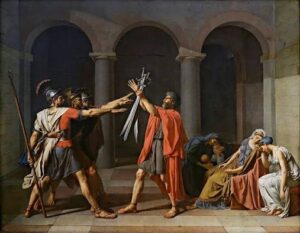 Figure 1 – The Oath of the Horatii.
Source: DAVID (1784), Wikimedia Commons.
The neoclassical painting The Oath of the Horatii by Jacques-Louis David presents the legend in which three Roman brothers swear loyalty to their father in order to defend the city of Rome against a rival city, Alba Longa. Here, we see a representation of loyalty, patriotism, and honor—concepts we may consider “moral and ethical.” However, can we say that the beauty and value of this painting lie precisely in the representation of these concepts? If we answer affirmatively, we surrender to the utilitarian character of art and attribute it as the factor that expresses the beauty and value of the painting. Instead, I argue that the more fruitful perspective is to recognize these characteristics in the very existence of the painting itself. By analyzing art from this point of view, aesthetics, beauty, and their necessary characteristics—the materials, ideas, and concepts that make them exist—take center stage in the experience, allowing us to recognize the true value of art. In short, attempting to assign utilitarian value before recognizing the intrinsic value of art’s existence diminishes art in its essence.
Conclusion
In this essay, we explored Schiller’s aesthetic-moral theory, considering the historical context in which he formulated his ideas and his investigation into the utilitarian character of art in relation to humanity. We concluded that, despite good intentions, Schiller ultimately proposes a perspective that devalues and removes the autonomy of art, beauty, and aesthetics by valuing them according to their utilitarian characteristics.
Nevertheless, despite the potentially problematic consequences of the Schillerian perspective, some praise can still be offered. Schiller’s theory was developed under the shadow of an intensely hyper-rationalist Enlightenment and was heavily influenced by Kantian thought. Thus, the integration between the sensible and the rational that Schiller formulated is noteworthy, even if ultimately flawed. The aesthetic letters are among the most influential works of German Idealism and of the history of aesthetics as a philosophical discipline. Understanding both their strengths and weaknesses is essential if we are to understand our current thinking about art and how to move forward toward a perspective that values art in its own essence.
Bibliography
• MOLAND, L. L. Friedrich Schiller (Stanford Encyclopedia of Philosophy). Available here.
• EAGLETON, T.; BLACKWELL PUBLISHING. The Ideology of the Aesthetic. Malden etc.: Blackwell Publishing, 2014.
• SCHILLER, F. On the Aesthetic Education of Man in a Series of Letters. São Paulo: Iluminuras, 2002.
• DAVID, Jacques-Louis. The Oath of the Horatii. 1784. Oil on canvas, 330 cm × 425 cm. Louvre Museum, Paris. Available here.