A Tale of a Prisoner
“Kiedy wymawiam słowo Nic,stwarzam co, co nie mieści się w żadnym niebycie”
“When I pronounce the word Nothing,I make something no non-being can hold.”
Wisława Szymborska, The Three Oddest Words [1]
Language shapes our perception of the world. Language becomes the perception on itself, as we express it to others and materialize it to ourselves with an inner voice. That perception relates to how further reason is conceived, as a way of reasoning answers to a perception of reality. We are shaken by the way we express reality to ourselves, by thinking this must be true and absolute, a neutral expression of experience of a world where we can be free. But it is the proposal of power relations made by Foucault what will question the existence of such a state in the given social structure, where freedom becomes conditioned to a discourse as it defines and conceives what can be considered as truth inside language. Given the latter, how can it be understood for humans to be considered free?
Firstly, the idea of language as an expression and mechanism of power relations must be further explained. The nature of these relations will be detailed later, but as of now power will be referred to as a relation, not an object, where there is an inequality in possibility of action. It is precisely in this possibility of action that power takes form. As Foucault argues, power acts upon actions themselves (1982, p. 789) [2]. It modifies, guides, and conditions the possibilities available within a relation without ever becoming a possession of either subject. This advantage within the relation permits the control of certain means through which the relation may reproduce and preserve itself over time. One of the mediums for this is language, as it establishes what and how we can express thoughts, therefore by controlling it and assigning a framework of acceptability to it that corresponds to the discourse produced by the relation, it reflects a position of power through expression, through language itself. It is precisely because of this that language cannot be considered as neutral as it expresses a position and facilitates its reproduction as a mechanism for power.
Power relations construct and take part in every social relation; this is fundamental to understand the base of thought in this argument. Three of its properties will be explained:
1. Power relations reproduce historically. They are, much like energy, conserved. This is not to say that they remain identical through time, but that they do not simply vanish. Rather, they transform, adapt, and relocate themselves within new social and historical circumstances. The relation changes its form while preserving its presence. Power takes and does what it can in order to reproduce and prolong its position for as long as possible.
2. Power relations produce discourses. The discourse is understood as the expression of a form of reasoning that responds to social and historical circumstances under a position of power. What is fundamental about discourse, however, is not merely its expression, but the framework it establishes through which certain truths, actions, thoughts, and forms of knowledge may be admitted while others are excluded. Truth, then, ceases to be an independent category and becomes something organized and distributed through discourse itself. The discourse is attributed to institutions instead of subjects. Further on, discourse is considered to be composed of action and speech. The latter is the linguistic part of the discourse meaning that it is not necessarily tangible as its counterpart is, due to the exclusion of the action.
3. Even through the act of resistance, the structure of power relations cannot be entirely escaped. An act of resistance opposes a structure considered valid in a society. But as power relations are ever present in social interactions, the individual remains attached to them insofar as they participate within society. The concept of resistance itself is in relation to the pre-existence of a power relation; it not only acts in response to the latter and its historic adaptations but produces possibilities of action that were not previously considered under the power structure. Simultaneously, the act of resistance is productive, it goes back to the power relation in the form of tangible consequences that result in adaptation from the relation.
It was previously mentioned that discourses are not a matter of individuals but of institutions. An institution constitutes a structured manifestation of power through which a relation may acquire permanence beyond the subjects that participate in it. What would otherwise remain attached to a singular position can now preserve and reproduce itself through the institution. This is useful in several aspects. First, and most evidently, it permits a centralized structure of power much like the one proposed in the Panopticon, although in a more abstract sense. Control is no longer dependent on the direct presence of the relation itself, but on a structure capable of maintaining and reproducing it. Second, discourse may now be attributed not to a subject but to an institution, allowing it to acquire a greater degree of legitimacy and permanence. Both of these aspects relate to a third consequence: resistance is lowered. As resistance opposes the current state of a relation of power, its objective is no longer singular and fragile, but a structure of distributed and intangible power. Power ceases to appear as the property of an individual and becomes embedded within the institution itself, making it increasingly difficult to isolate, confront, and resist.
Consequently, the idea of language as a mechanism of power becomes institutionalized, allowing for its systematic regulation and control. Through this process, conceptions, actions, and possibilities of expression become increasingly conditioned by the structure of power itself. The limitation of thought through language is perfectly exemplified and narrated by Orwell:
“How could you have a slogan like ‘freedom is slavery’ when the concept of freedom has been abolished? The whole climate of thought will be different. In fact there will be no thought, as we understand it now. Orthodoxy means not thinking – not needing to think. Orthodoxy is unconsciousness.”
George Orwell, 1984, 1949 [3]
The perception of the world is delimited by how it may be expressed, or in other words, by language. To abolish a word is not merely to suppress a sign, but to alter the horizon through which a reality may be conceived. What disappears is not only the term itself, but the possibility it once contained. Language generates certain conditions of possibility and therefore limits others. Words carry meanings that may be admitted or rejected by discourse, and in doing so determine what can be recognized, expressed, and understood. The differences that emerge in the translation of a phrase illustrate this process. Certain meanings become impossible to transmit not because they do not exist, but because the linguistic structures through which they would be expressed have developed under different social, cultural, and historical conditions. Such limitations are not accidental; they are historical. They emerge through discourses that reproduce themselves over time, which is precisely why Orwell’s literary example reveals a mechanism already present within language itself.
Language establishes what and how thoughts may be expressed, and if institutions under a discourse regulate such language, knowledge itself becomes situated within the same framework of validity proposed by the relation of power. What may be recognized as knowledge is therefore not detached from discourse but emerges through the categories that discourse admits as true. Knowledge acquires meaning within a particular historical and social configuration, and it remains conditioned by the same structures through which discourse reproduces itself.
By understanding knowledge as an exercise of reason, reason itself cannot be thought as entirely external to discourse. The forms through which arguments are validated, concepts are organized, and truths are recognized emerge within a particular historical framework. This does not render reason impossible, but situates it. Reason remains exercised through discourse and therefore within the limits and possibilities established by it.
Even with the restrictions, limitations and control exerted by the relations of power, it is essential to think of them not as exclusively restrictive, but productive as well. The situations they create give space to opposition, to resistance. Foucault does not deny its existence in such a system, on the contrary, he states: “qu’il n’y a pas de relations de pouvoir sans résistances […] elles existent d’autant plus quelles sont là où est le pouvoir.” (145) [4]. Meaning that they not only exist simultaneously, but in the same space as the relations of power. This space we will call language, as they both must express themselves through it, they are discursive. As language is conditioned by the relations of power and progressively more controlled, in contrast to Foucault I will say that resistance not only coexists with the relations of power, but is conditioned on its expression through language, as that is held by the relations themselves. This means that those means must be either expanded or exposed in order to commit an act of resistance towards the system.
Under the scope of linguistic expression, two types of resistances are to be considered:
1. Critique, which allows us to question a certain stablished system, ideology, or argument. It is fundamental to avoid the loss of diversity in reason and is in relation as well to historical context.
2. The act of naming, as the more productive side of resistance, allows for the creation of new names that simultaneously create possibilities of action. It has a necessary social conception, as there is no language without society.
Moreover, critique acts as the first step to the act of naming, as it provides a justification to the action. That is to say that naming without purpose is straight absurdism, and as it does not communicate because it lacks sense/meaning, it does not comply with the social characteristic of resistance. Thus, critique is required.
Critique demands a plurality of perceptions that, as reason becomes increasingly delimited, grow progressively scarce. The reduction of such plurality diminishes the possibility of resistance, for resistance itself depends upon the existence of alternatives capable of confronting the current discourse. A relation of power is strengthened when its discourse ceases to appear as one possibility among many and instead presents itself as the only conceivable framework through which reality may be understood. Resistance therefore requires not only opposition, but the preservation of difference. It depends upon the existence of perspectives, concepts, and forms of reasoning capable of revealing the contingency of what has been accepted as truth.
The consequence of this limitation extends beyond discourse itself. If language conditions what may be expressed, and discourse determines the framework through which truth is recognized, then the question inevitably reaches freedom. What remains of freedom when the possibilities of expression, knowledge, and reason are already conditioned by relations of power?
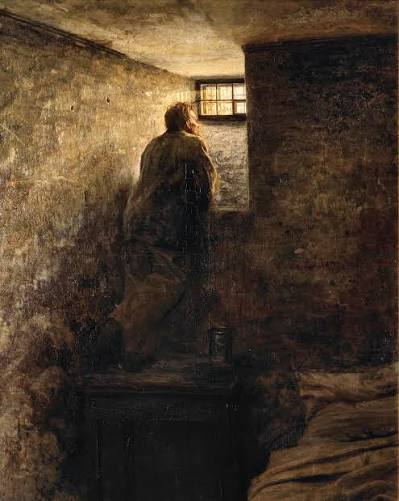
The analysis must surge from a much less tangible and more abstract interpretation of resistance. Let us imagine a prisoner. Now, by social convention and factuality, it would be said that such individual is not free, they are confined to a physical space in which their movement and actions are carefully enabled. Nevertheless, this same individual can consider themselves free, in disregard of their physical conditions.
To consider this case we must understand two viewpoints of the subject as described by Foucault:
1. The role given by the discourse to an individual, with responsibilities to fulfill and expectations inside society. This subject is punished for not following the order of things. We will call this vision the external subject.
2. A subject, an identity, that corresponds to a perception of self. This will be referred to as the internal subject.
Note that Foucault did not make explicit this separation on the concept, but the existence of these two different perspectives allows for a difference in the perception of freedom, so they will be considered as independent.
The existence of this new perspective proposed by the prisoner presents a contradicting statement to the stablished order. And the distinction between both concepts leaves a difference in perception useful to comprehend the origin of the element of freedom in the exercise. While the social construction of the subject is fixed upon the individual, experiences still shape reasoning and knowledge for the internal subject, that is to say, that the discourse does not have complete hold of the internal subject as it does with its external version. Regardless, this does not mean that the internal subject, from where this proposition is found, is indistinct to discourse, but more like it exists within a more creative and flexible structure that produces acts of resistance trough variations of reason during the construction of the self-subject to allow stretching the limits of what the structure has determined.
Freedom, then, cannot be understood as existing beyond the relations of power, for such a position would require a distance from discourse itself. Yet neither can it be reduced to the conditions imposed by those relations. The same structures that delimit possibilities simultaneously reveal their limits through resistance. The frameworks through which knowledge is legitimized and reason is exercised remain equally situated within this tension. Critique and naming expose what has been accepted as natural and reveal it as historical, contingent, and therefore susceptible to transformation.
The question is no longer whether human beings are free in the absence of power, but how freedom may be conceived within it. If discourse conditions what may be expressed, recognized, and understood, resistance persists in confronting those conditions and revealing them as neither absolute nor immutable. Freedom remains situated within this tension, not as an escape from discourse, but as the possibility of questioning and transforming the limits through which reality is conceived.
References
[1] Szymborska, Wislawa. The three oddest words. Ciscio.io.
[2] Foucault, Michel. “The Subject and Power.” Critical Inquiry, vol. 8, no. 4, 1982, pp. 777–95. JSTOR
[3] Orwell, George. 1984. Penguin Random House. 2024.
[4] Foucault, Michel. « Pouvoirs et stratégies » : Dits et écrits III. 1994. This quote was taken from the original text in French due to inaccuracies in the English translation.